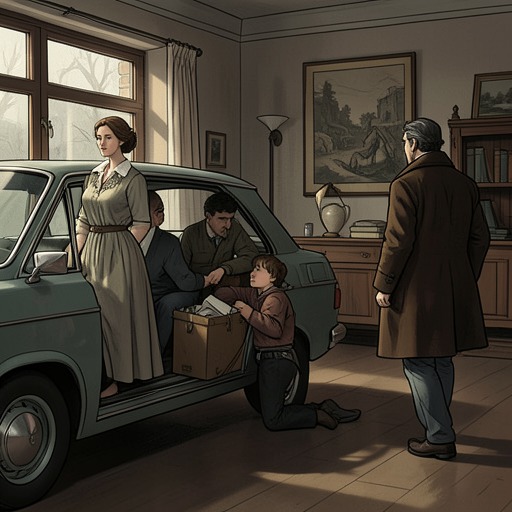
Discovery of Lady Deane's hidden fortune
Partners in CrimeThe discovery of Lady Deane’s hidden fortune is the solution to the mystery at the Red House: what appears to be an old woman’s jumble of recipes and papers contains directions to wealth deliberately concealed in the garden. Tuppence and Tommy solve the puzzle by linking an apparently familiar verse to a biblical injunction, then testing its answer against the practical details of Lady Deane’s habits. The final answer is not merely a buried cache but an inheritance recovered in forms that explain how its owner preserved and concealed her assets—and that gives Monica Deane the means to choose a life with Gerald rather than marry for security.
The Clues in the Papers
The search turns on an assortment of papers, among them a short charade that Tommy had set aside because it seemed peculiar. Its opening lines direct the reader to put something on glowing coal and put the whole into it; the subsequent clues refer to something that is itself the first, and to something that dislikes the wintry blast. Tuppence first identifies the charade as a familiar kind of old-fashioned puzzle, but the decisive signal is not its form alone: the words “St. Luke XI. 9” are written beneath it.
Tuppence looks up the reference in a small red Bible. The verse reads, “Seek, and ye shall find.” That text turns the charade into a purposeful instruction rather than an isolated scrap: the concealed fortune is to be found by following what the riddle says. The discovery depends on reading the documents together. A verse that might have looked like a pious note becomes a pointer, while the charade supplies the word that leads from the papers to a specific household object and then to a place outdoors.
The answer comes to Tuppence while she and Tommy are discussing potatoes. She connects the first part of the verse to a pot, the second to the letter A, and the third to cold toes. The resulting word is “potatoes.” At first Tommy objects that potatoes have no evident connection to missing treasure. The clue only becomes actionable when he remembers a recipe among the papers: “TO KEEP NEW POTATOES. Put the new potatoes into tins and bury them in the garden. Even in the middle of winter, they will taste as though freshly dug.” The recipe converts a wordplay solution into a testable method of concealment.
From Recipe to Garden
The recipe still leaves open whether Lady Deane actually used the practice it describes. The following morning is Christmas Eve, and Tuppence asks the old gardener about burying potatoes in tins, presenting the question as curiosity about having new potatoes with Christmas turkey. He confirms that Lady Deane did bury three tins each summer, and that she often forgot to have them dug up again. His recollection supplies the number of containers and establishes that the recipe was not merely a general instruction.
The gardener also identifies the location. The tins were not usually buried in the bed by the house, as Tuppence initially asks; they were placed against the wall by the fir tree. That correction narrows the search to a precise spot. The garden’s ordinary practice—potatoes stored for later use—has become a hiding system, and the gardener’s casual memory is the missing link between the written clue and the buried objects.
That night, Tommy and Tuppence enter the grounds with a spade. Tommy digs where the gardener directed, and the spade strikes metal. The first biscuit tin is sealed with adhesive plaster; once Tuppence opens it with Tommy’s knife, it proves to contain potatoes and nothing else. The next tin also fails to disclose the fortune. The repeated disappointment makes the instruction seem increasingly literal and increasingly unpromising: two containers hold precisely what the recipe said they would hold, without the treasure the investigators seek.
A third tin finally changes the meaning of the search. Tuppence starts to exclaim that it contains potatoes again, then sees that the potatoes are only a top layer. Beneath them is a large, old-fashioned velvet bag. Tommy tells her to take it back while he replaces the earth, insisting that the bag remain unopened until he joins her. The concealed wealth has been hidden not in place of the potatoes but underneath them, using the expected contents as cover.
What the Cache Contains
At the inn, Tommy and Tuppence open the bag. Inside are two separate packages: an oil-silk-wrapped parcel and a heavy chamois-leather bag. The leather bag contains gold sovereigns, which Tommy counts as £200. He infers that this may be the amount Lady Deane was permitted to have, though the precise circumstances of that limit are not established in the discovery itself.
The oil-silk parcel contains closely folded banknotes. Tommy and Tuppence count them carefully: they total exactly £20,000. A smaller parcel wrapped in tissue paper holds a finely matched string of pearls. Tommy estimates that the pearls are worth at least another £5,000. The denominations and packaging give the find a concrete scale: sovereigns, banknotes, and jewels have all been kept together, but protected and separated rather than left as a single undifferentiated hoard.
Tommy connects the pearls to a newspaper cutting Lady Deane had kept about pearls as a good investment. He concludes that she must have realized her securities and converted them into notes and jewels. This is an inference from the combination of the clipping and the recovered valuables, not a demonstrated account of every transaction. Even with that qualification, the contents suggest deliberate conversion and concealment: an investment in pearls, portable cash, and a small amount of gold lie together in a tin among stored potatoes.
Monica’s Prospects
The fortune matters because Monica has already described the financial pressure shaping her future. Selling the house would not bring in enough for her to live on. Gerald, whom she cares for, is a talented but desperately poor engineer; with capital, his firm would take him into partnership. Mr. Partridge is a good and well-off man, and marriage to him would end her troubles, but Monica cannot make that practical security equivalent to love. The treasure therefore changes the conditions of a choice that had seemed to pit affection against financial survival.
When Tuppence celebrates the find, she says that Monica can now marry the young man she loves and live happily. The recovered wealth is not simply a solution to the mystery or an abstract increase in the family’s assets: it supplies the capital missing from Gerald’s prospects and removes the necessity of a financially expedient marriage. In this way, the clue chain resolves two puzzles at once—the location of Lady Deane’s property and the practical obstacle to Monica’s future with Gerald.
A Domestic Riddle as Detection
The solution proceeds through ordinary things rather than specialized forensic expertise: a handwritten charade, a Bible reference, a recipe, a gardener’s recollection, a spade, and three tins. Each clue acquires force only through comparison with another. The biblical phrase directs the search, the riddle yields “potatoes,” the recipe suggests burying them in tins, and the gardener fixes both the number and the place. The sequence models detection as patient cross-checking, with household knowledge proving as indispensable as puzzle-solving.
The first two tins sharpen the final reversal. If every container had immediately yielded treasure, the recipe would have functioned only as a cipher. Instead, the potatoes are genuine, and the search nearly appears futile; the third tin preserves the same expectation before revealing the velvet bag beneath the crop. The answer is concealed inside the ordinary explanation, not substituted for it. Lady Deane’s cache is found because Tommy and Tuppence take the domestic clue literally, follow it into the garden, and continue after the first results seem to confirm only that potatoes are potatoes.